[90ies rave information content of our second event Sound System Culture – On the Radical Roots of Rave – Chapter #2]
When rave culture took over the world, the UK youth had to fight for their right to party. Section 63 of the 1994 Criminal Justice Act was the law that made raving impossible. The law forbid gatherings and the police was raiding the suburbs and outskirts of the cities, stopping any activities they considered suspicious. On one of the occasions a helicopter and an enforced squad were sent to stop a birthday party (!) in a house outside
a city.
More than 5000 people went to the streets in London to defend their right to dance.
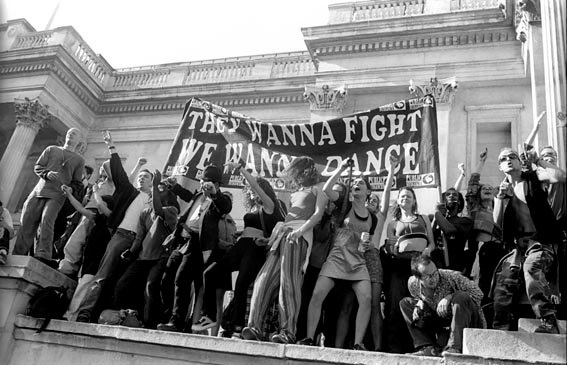
(Photo: Ravers protesting against Section 63 of the 1994 Criminal Justice Act, source: vice)
“The bill made an impact because the summer before everyone felt like we could take over the world,” says Chris Liberator, one of the three Liberator DJs (alongside Julian and Aaron) who started out in London’s punk squat scene, then moved up to playing techno at eviction parties and now at clubs and festivals all over the world.
Likewise, fury over the impending legislation spawned a new wave of activism. “In many ways the Criminal Justice bill was counterproductive,” says Keef of Midlands-via-Glasgow sound system Desert Storm. “The demonstration in London brought together an eclectic group of people; from sound systems and squatters to trade union movements. Joining a previously fragmented scene into a unified force led to new projects, like Reclaim the Streets (a collective with a shared ideal of community ownership of public spaces).”
Some sound systems, like Spiral Tribe and Bedlam, moved to France, then took the party across Europe.
Many of those involved in the early free party scene have gone on to run records labels, play at or organise licensed events or work in the festival circuit. Resuming we can say that the relationship of (illegal) rave culture and club culture is in a constant movement, going back and forth between monetizing something that started out as a protest and reclaiming what has been taken over by capitalism.
Sources: technostation.tv, vice.com, wikipedia.com


 Sound System Culture
Leave a comment